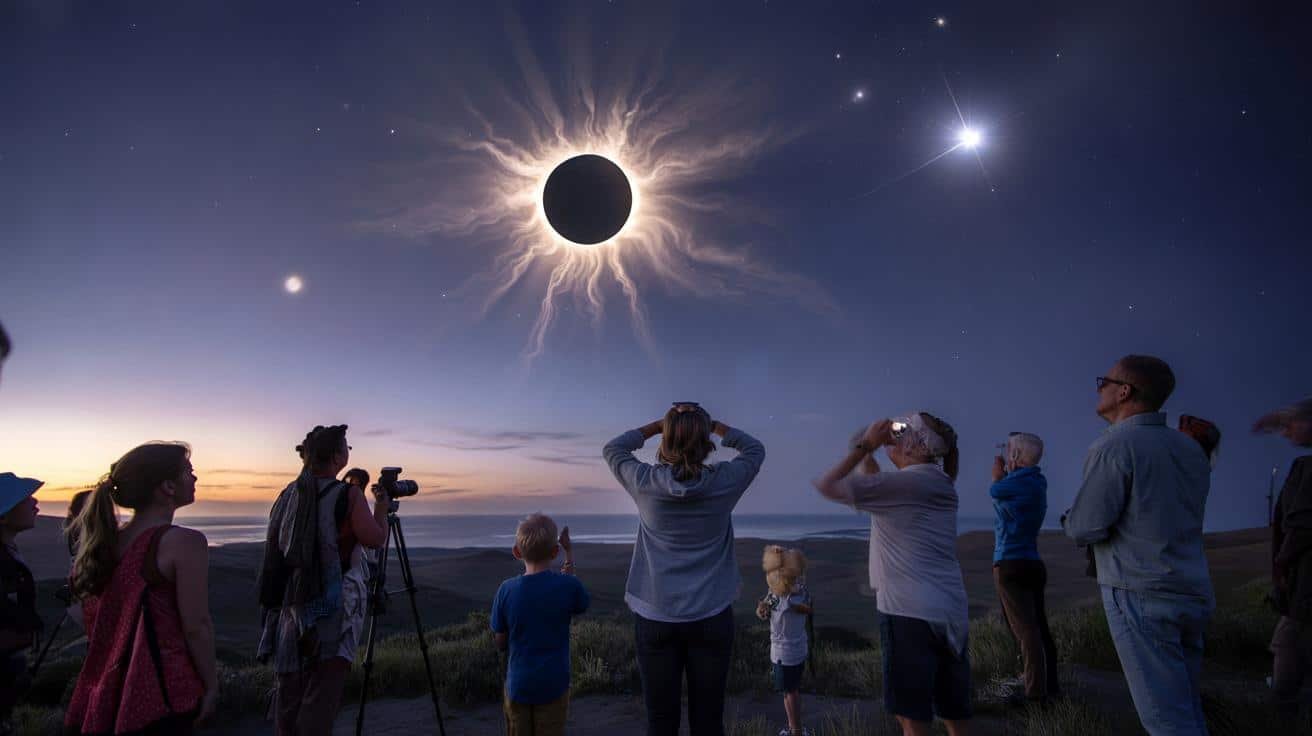
Just before noon, the streets go strangely quiet. Birds stop singing mid-phrase, dogs fall silent, and that usual white midday light turns a deep, uneasy blue. People step out of offices with flimsy cardboard glasses, kids grip their parents’ hands a little tighter, and for a few minutes the world seems to hold its breath. Above them, the sun is slowly being eaten away by a perfect black disc. Someone whispers, “This can’t be real,” even though they’ve known the date for years. Then, in an instant, the last sliver of light vanishes and day collapses into night.
Your watch keeps ticking, traffic lights are still glowing red, yet everything feels suspended.
Six minutes never felt so long.
The exact date and why this eclipse is unlike anything you’ve seen
Mark your calendar: the “eclipse of the century” is set for **June 13, 2132**. Astronomers have been circling this date for decades, not because it’s the next eclipse, but because of its sheer length and geometry. For a stretch of the Earth, the moon will slide so precisely in front of the sun that totality will last close to six full minutes, a span of darkness most people alive today will simply never experience.
On the narrow path of the umbra, day will flip to night, stars will appear, and the sun’s ghostly corona will bloom like a pale white crown around the black moon.
Outside that path, millions more will stand in a weird, eerie twilight.
If that date sounds abstract, think back to 11 July 1991. That eclipse, crossing Hawaii and Mexico, was nicknamed the “eclipse of the century” for that era, offering up to 6 minutes and 53 seconds of totality in some spots. People still talk about it with the kind of nostalgia usually reserved for concerts or World Cup finals. Hotel roofs in Baja California were packed with improvised viewing parties. Radios crackled with live commentary as day plunged into night.
The 2132 event plays a similar role for this century’s skywatchers. It’s the one astronomers will compare all others to, the kind kids in 2100 will hear about in school when teachers want to explain just how dramatic the dance between sun, moon, and Earth can be.
A once-in-many-lifetimes kind of show.
Why so long? The answer lies in celestial choreography. To stretch totality, you need three things to line up: the moon relatively close to Earth, the Earth at the right distance from the sun, and the shadow track passing near the equator where the planet’s surface spins fastest under the moon’s shadow. When those variables click together, the moon’s dark core shadow, the umbra, lingers over one spot for longer than usual.
Most total eclipses offer two to three minutes of darkness at best. Six minutes changes the whole experience. You have time to breathe, to look away from your camera, to scan the horizon glowing with a 360-degree sunset, to listen to the sudden chill in the crowd.
It stops feeling like a quick magic trick and starts feeling like another planet.
Six minutes of total darkness: what you’ll feel, what to do, what not to do
There’s a rhythm to a long total eclipse. About an hour before totality, the sun looks like someone’s taken a tiny bite out of it. That bite grows as the partial phase quietly unfolds. The light becomes thinner, shadows sharpen into strange double or triple edges. A few minutes before totality, the temperature drops, the wind can shift, and many people feel a little rush of adrenaline they didn’t expect.
Then come the last seconds: shimmering “shadow bands” racing over pale surfaces, the sun shrinking to a thin ring of blinding white. For safety, you’re still wearing your eclipse glasses.
When that last bead of light pops off the rim, you pull the glasses away and the world falls into an impossible twilight.
The most common mistake during a long eclipse is trying to live it through a screen. People fiddle with camera settings, argue with tripods, or frantically refresh live streams while the sky is literally opening above them. We’ve all been there, that moment when the phone in your hand steals the memory you actually wanted. Totality feels like forever until it doesn’t. Those six minutes evaporate if your eyes are locked onto gear instead of the horizon.
Let’s be honest: nobody really nails the perfect eclipse photo on their first try.
The people who walk away glowing are usually the ones who look up, breathe, shout, or just stand there quietly taking it in.
During the 2017 eclipse over the US, an astronomer in Oregon told me, “I’ve studied the corona my whole career, and yet every time I see it with my own eyes, my brain just… stops. Equations don’t help you when the sky goes black at noon.”
- First minute – Look directly at the black disc and corona with your naked eyes. Notice the delicate, feathery tendrils of light stretching far beyond the sun’s usual edge.
- Second minute – Scan the horizon. You’ll see a ring of orange and pink all around, like a 360-degree sunset wrapping the world.
- Third minute – Drop your gaze to the people around you. Some are crying, some laughing, some swearing softly. This shared reaction is half the magic.
- Fourth minute – Glance at the brighter stars and planets that may appear: Venus, Jupiter, maybe even Mars, shining in midday darkness.
- Fifth and sixth minutes – Put the camera down, if only briefly. *Let your brain record the sheer weirdness of night dropping out of a clear blue sky and then lifting just as fast.*
The best places on Earth to witness the “eclipse of the century”
Every total eclipse draws a narrow shadow path, rarely more than 200 kilometers wide, across the globe. For the 2132 event, astronomers project a track sweeping across parts of the Pacific, brushing remote islands and sections of continental coastline before fading out at sunset. The sweet spot? Locations sitting close to the centerline of that path, where totality will stretch closest to the six-minute mark and the sun will stand relatively high above the horizon.
Historic eclipse chasers often favor dry climates and high altitudes, where clouds are less likely to spoil the show. Observatories, deserts, and coastal highlands become temporary capitals of the sky.
Some towns plan for this years in advance without even realizing just how big it will be.
Think of what happened in August 1999 in places like Cornwall in the UK or Reims in France. Small coastal villages suddenly found themselves packed with tripods, folding chairs, and camper vans from Germany, Spain, the Netherlands. Farmers rented out fields for tents. Pubs opened early, serving breakfast to people who had been awake since 4 a.m., nervously tracking clouds. When the shadow finally swept over, there were gasps followed by a strange, communal silence as daylight drained away.
For the 2132 eclipse, similar scenes will unfold wherever the path crosses land. Expect hotels and guesthouses along that line to fill years ahead. Some cruise companies will plot special itineraries, maneuvering ships into the center of the shadow in the open ocean to give passengers a full view above potential coastal haze.
Entire local economies can get a temporary, very surreal boost from six minutes of darkness.
Choosing your spot will depend on what experience you want. Photographers may chase dry air and mountain plateaus to catch razor-sharp coronal detail. Families might prefer small, welcoming towns along the centerline, where local parks and sports fields turn into safe, relaxed viewing zones. City dwellers could aim for mid-size cities under the path that will host festivals, concerts, and science outreach events in the days leading up to totality.
There’s also a quieter option. Some people deliberately pick remote locations: an empty beach, a countryside hill, a small island. They want the soundscape of the eclipse to be birds, waves, and their own heartbeat instead of crowd cheers.
The rarest luxury in a world obsessed with content might be watching the sky go dark without posting about it until much, much later.
Some events are so big, you can plan for them decades out and still feel unprepared on the day. A century-defining eclipse sits firmly in that category. You can count down, buy the glasses, book the hotel, and study the maps. You can memorize the timings, the phases, the safe viewing rules. Then totality hits, and your carefully organized checklist shrinks against the sheer, visceral weight of seeing the sun erased in real time.
People who’ve witnessed even modest total eclipses often say the same thing: once you’ve seen one, partials don’t quite cut it anymore. The bar for awe permanently shifts. You may find yourself planning trips you never would have considered, just to stand under that shadow again.
An eclipse like the one coming in 2132 won’t just bend light and shadow over a thin strip of Earth. It will bend thousands of individual life stories toward one shared moment of darkness and astonishment.
| Key point | Detail | Value for the reader |
|---|---|---|
| Exact date and duration | Total solar eclipse on 13 June 2132, with up to around six minutes of totality on the centerline | Gives a clear reference to understand why this event is being called the “eclipse of the century” |
| Experience of totality | Shift in light, temperature drop, visible corona, stars and planets, intense crowd reactions | Helps readers picture what they’ll actually feel and see, not just the technical description |
| Best viewing strategy | Pick a spot on the path of totality, prioritize clear-weather regions, watch with eyes first and camera second | Offers practical guidance to maximize those brief minutes of darkness and avoid common regrets |