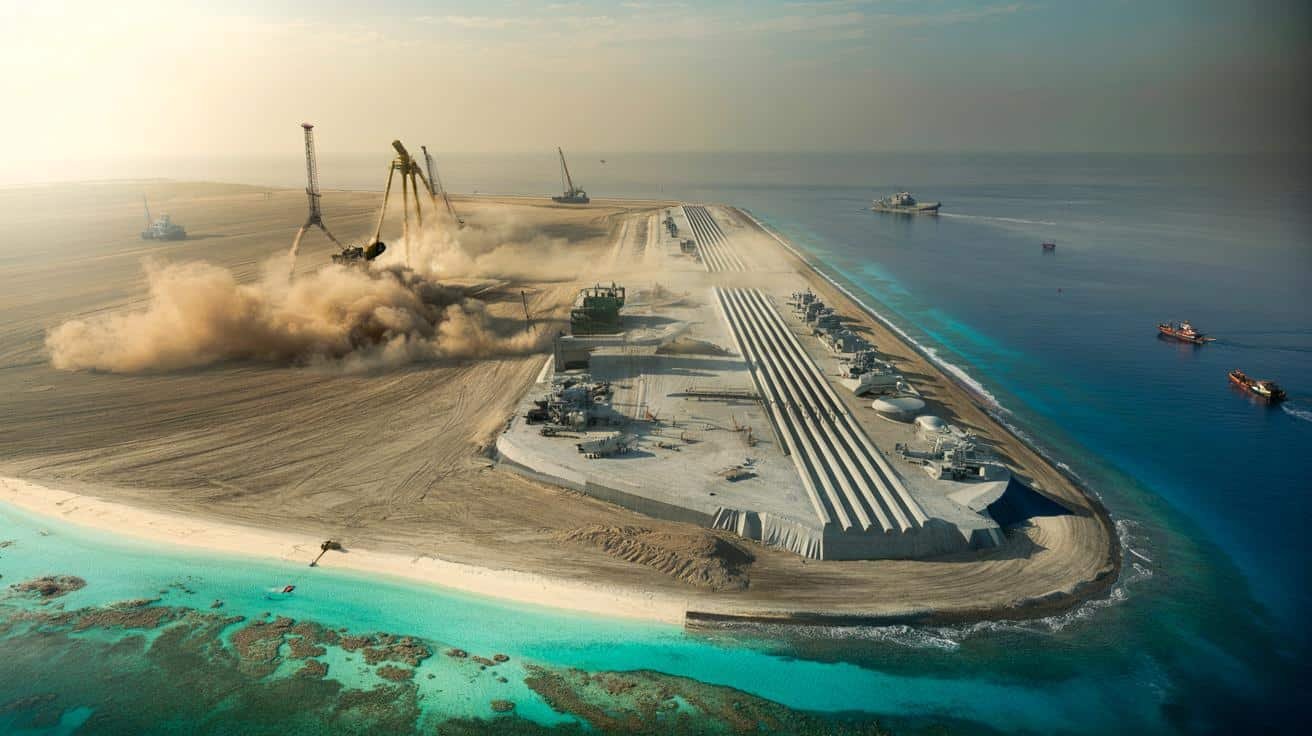
The first thing you notice is the sound. Not waves, not gulls, but the grinding roar of machinery where there should be only sea and wind. On the horizon, what looks like a pale-gray island rises out of the turquoise water, its edges unnaturally straight, like someone dropped a parking lot into the middle of the ocean. Ships move in slow circles, sluicing muddy water and crushed coral, while cranes swing giant hoses that pour concrete into the shallows. The air smells of diesel and wet limestone. Somewhere under those slabs lies what used to be a reef, alive with fish and coral polyps.
From a distance, it just looks like construction. Up close, it feels like someone is redrawing the map.
From hidden reef to fortress island
A decade ago, most of these reefs in the South China Sea barely broke the surface at low tide. Sailors knew them as hazards on the chart, fishermen as places where the water turned suddenly bright and shallow. Today, many of those same reefs have runways, radar domes, and anti-aircraft batteries.
China has poured literally millions of tons of concrete and sand into disputed shallows, turning what were once underwater specks into permanent outposts. It’s like watching a time-lapse of a city being built on fast-forward, except the “land” didn’t exist at all before the dredgers arrived.
Take Fiery Cross Reef, once a narrow ring of coral barely peeking out of the sea. Satellite images from the early 2010s show a pale halo in a deep blue nowhere. Then, sand barges arrive, dredgers chew into the seabed, and the halo swells. Within a few years, that faint ring becomes a 3,000‑meter airstrip with hangars, a harbor, radar arrays, and hardened shelters.
Subi Reef and Mischief Reef follow, spreading like concrete lilies. Each new aerial photo tells the same story: turquoise lagoons darkened by sediment, coral heads buried, straight lines replacing organic curves. At sea level, fishermen describe the change more bluntly. One day it’s a reef, the next it’s a restricted military zone.
Promoted Content
This pace isn’t some random construction spree. It’s a calculated way to turn a legal gray area into a physical fact. Under the UN Convention on the Law of the Sea, low-tide elevations and submerged reefs don’t generate territorial waters or exclusive economic zones. But full-fledged islands with “permanent installations”? Those can.
By pouring concrete over shallow features, China effectively tries to upgrade the status of these specks, staking broader claims across a sea claimed by several neighbors. It’s cartography by cement truck. The world sees the before-and-after photos and argues over law; on the water, patrol boats and runways quietly shift the reality on the ground — or rather, on the newly-made ground.
How a reef is turned into a runway
The process starts with a survey ship and a handful of coordinates. Engineers identify a reef or shoal shallow enough to work with and sheltered enough to defend. Then come the dredgers, those hulking ships that scoop sand and crushed coral from the seabed and pump it through long pipes onto the chosen reef.
Layer after layer, the shallow lagoon rises. Bulldozers and excavators, ferried in by barge, smooth the slurry into a flat, compacted platform. Then the concrete begins to flow — thick, gray, and relentless — from mixer ships and floating plants, forming sea walls, piers, and runway foundations. In a matter of months, what used to vanish at high tide stands dry and solid in a storm.
A lot of us imagine big infrastructure as something that belongs on land — highways, bridges, airports. This is all that, but transplanted onto coral skeletons and sandbars. Mistakes are common in the early stages: walls collapse, foundations crack, storms bite into newly piled sand. Crews respond by adding more rock, more concrete, a breakwater here, a causeway there.
The pace is relentless because time itself becomes a weapon. The longer a structure stands, the more normal it looks on maps, on screens, in people’s heads. Over a few years, a patch of reef hardly anyone could find on a globe becomes a named “island” with a helipad, fuel tanks, and a permanent military garrison. Once that happens, nothing about it feels temporary anymore.
All of this sits on a fragile base. Coral reefs grow slowly, millimeter by millimeter, while dredgers erase them in a season. Marine biologists talk about crushed habitats, clouded water that smothers coral, and fish stocks that simply don’t come back. Local fishermen from the Philippines, Vietnam, and Malaysia tell stories of being turned away from grounds their families used for generations.
Let’s be honest: nobody really reads a legal ruling or a press release and feels the seabed changing under their feet. What people grasp is what they see and can’t unsee — runways where there were waves, ships shadowed by radar domes, a horizon now carved by concrete. *Once a reef becomes a military outpost, it rarely goes back to being just a reef again.*
What this means for the rest of us
If you look closely at how China built these islands, you start to see a playbook for changing reality step by step. First, pick something that seems too small or remote for anyone to fight over. Then, establish a “presence” — a small pier, a flag, a weather station. After that, scale up: dredgers arrive, then engineers, then soldiers.
Each physical upgrade shifts the conversation. Protests that once focused on “you can’t claim that reef” morph into “you can’t militarize that base”. The original question — who owns a rock beneath the waves — gets buried under radar towers and concrete runways. The lesson is chillingly clear: control often goes to whoever is willing to move the most earth and pour the most cement first.
It’s easy to look at satellite images and think all this is abstract geopolitics. Yet for people in the region, these new islands have changed daily routines in subtle but very real ways. Fishermen reroute their trips to avoid patrol boats and “forbidden zones”. Airline pilots adjust flight paths. Naval crews find themselves crossing invisible lines that didn’t exist a decade ago but are now enforced by patrols and radio warnings.
We’ve all been there, that moment when a temporary workaround — a shortcut, a small exception — slowly hardens into the new normal. In the South China Sea, those shortcuts are made of concrete, and the “new normal” has 10‑story radar towers and missile shelters. The scale is different, but the human habit feels eerily familiar.
“Facts on the water quickly become facts on the map,” a Southeast Asian diplomat told me once, half-tired, half-resigned. “By the time lawyers finish arguing, the runway is already open.”
- Concrete never sleeps: Once poured, it anchors not just structures but claims and narratives.
- Reefs are quiet witnesses: Their transformation rarely makes noise beyond the dredger’s roar, yet they reshape security for millions.
- Maps follow bulldozers: Boundaries drift toward whoever builds first and stays longest.
- Every pier has a purpose: Today a resupply dock, tomorrow a missile site or radar station.
- The sea remembers: Even if politics shift, buried coral and displaced communities don’t simply reset.
Living with man-made islands in a shared sea
The story of China’s concrete islands isn’t over; the slabs are still curing, the breakwaters still being extended, the harbors deepened. Other countries in the region are reacting in their own ways — patrols, alliances, legal cases, smaller-scale construction. The South China Sea has become a place where coral, concrete, and politics are forever entangled.
For the rest of the world, these new outposts are a kind of warning shot about how fast our planet’s blue spaces can be physically rewritten. What happens here doesn’t stay here: the shipping routes that pass between those gray runways carry energy, food, electronics, the stuff of daily life on almost every continent. The reefs that disappear under tons of cement once protected coastlines and fed families, not just in one country but around an entire semi-enclosed sea.
It’s tempting to see all this as distant and predetermined, like watching a storm move across a weather radar. Yet each satellite image, each new pier, reflects human choices — engineers signing off on designs, officials approving budgets, crews working day and night over living reefs. The next time you see a neat gray polygon on a South China Sea map, imagine the color it replaced: the shifting blues and greens of shallow coral, the lives above and below the waterline now pushed to the edges. That contrast, more than any treaty text, tells you what’s really at stake — and what might still be possible if the pouring ever stops.
| Key point | Detail | Value for the reader |
|---|---|---|
| Reefs turned into bases | China used millions of tons of sand and concrete to raise shallow reefs into permanent “islands” | Helps you understand how physical construction can quietly transform political realities |
| Step-by-step playbook | From survey ships to dredgers to runways and radar domes, control grows in stages | Offers a clear mental model for spotting similar strategies in other contested places |
| Impact beyond geopolitics | Local fishermen, ecosystems, and global trade routes are all reshaped by these artificial outposts | Connects a distant dispute to everyday life, from seafood prices to shipping delays |
FAQ:
- Question 1Are these man-made islands legally recognized as Chinese territory?
- Question 2How much concrete and sand has China actually used in the South China Sea?
- Question 3What kind of military assets are deployed on these artificial islands?
- Question 4How are neighboring countries responding to China’s island-building?
- Question 5Can these reefs ever be restored to their natural state once the concrete is in place?